Showing posts with label British Cycling. Show all posts

Wednesday, 7 December 2016

Is BikeAbility Useful


So, there was a little come back on the Volvo "educational kit" post I made last week. I did bring into question the nature of the Volvo idea and how it lacked substance compared to what we already do in the UK, BikeAbility. And the comeback was not about how bad the Volvo programme was, but how they don't like BikeAbility.

So, there was a little comeback, just not to me at all. I spotted it going back and forth on Twitter amongst people I know and often share discussions, enjoyment of riding, and fun with. They didn't include me for whatever reason, although that was a little disappointing. And it reminded me that there is a strong anti-training bent to some cycling advocacy people, some with good reason, and some a little less so.

So some of the issues fall down as follows.
  • Training doesn't increase the numbers of people riding.
  • The money could be better spent on building infrastructure.
  • It's just the foundation of vehicular cycling which for decades now hasn't worked for the UK.
Now, a few years back, I'd agree wholeheartedly with these concepts. However, having spent a considerable amount of time since then involved in BikeAbility, I think it's a lot more nuanced than that. There's just a lot more to it, it needs more consideration than just simple statements.


Cycling Levels


We'll start with cycling levels. First, a study has shown that BikeAbility does increase numbers riding to school.
"the survey results show trained children reported they cycle more often, cycle more to school, cycle more on the road, cycle with more confidence on the road, and enjoy cycling more"
This is something I've seen a lot of people denying. But it is there, BikeAbility does increase numbers riding to school (⁰ extra below). The obvious caveat is that this is still nothing like the revolutionary change in numbers required to make ourselves a cycling nation. What's important to note is that The Association of BikeAbility Schemes agrees with that last caveat. That's right, the people who deliver this training do not think it's the be all and end all of cycling. Training is not an alternative to good infrastructure. And that brings us on to the next bit, surely it's better to build infrastructure.


Infrastructure


Infrastructure is the way forward. Full Stop. It is the way in which we get more people riding, more often, and further. This needs to be done at a national level, with national standards, with joined up thinking between different authorities. At the moment we have small schemes, that do help locally, but are a long way from delivering the cycling infrastructure needed to make a difference, nationally.

So, what would it take to do this? Well, the Dutch experience tells us a minimum of £20 per head per year is something like it. That's around £2bn per year across the country (¹ extra below). And we'd need to do that for decades to catch up with the Dutch. What if we dropped BikeAbility for a year or two and took that money and put it into building? Well, at the last round BikeAbility got £50m for 4 years training. So that's £0.0125bn we could add into that £2bn per year, or just under 1% more. Anyone think that's going to make an iota of difference? No, me neither. And in the meantime children everywhere are not involved in any kind of formalised cycling fun (and I'll back that up later).


Vehicular Cycling


So, is it all about forcing children in front of lorries, getting them battle-scarred so they will either adapt (like the 2% of vehicular cyclists) or run away? This premis would suggest that the majority of kids learning will never do it again. But we know that doesn't happen. And actually BikeAbility is so much more than that.

For a start, level 1 never goes near a road. It's all about helping kids get to grips with controlling a bike, usually in a playground setting. It's a laugh! It's fun, it's riding around when they might have had Maths, English, or whatever. And that's a big point. It's fun!

Playing games during this is aimed to cover a series of simple outcomes, but it's still fundamentally bike control. Something you need to ride a bike, wherever you are. You'll be surprised just how many kids may have most of these, but still not quite it all. I think those who've ridden their bikes for a decade or three since, cannot remember those initial learning moments. Some do think there's no need for any training, just get on the bike and pedal. Well, at an early age there can be a lot more to it than that. True, it might not take long, which is why this course is just 2 hours.

So level 2 starts getting the kids on the road. Years 5 & 6 enrol to do this course, often decided by the school, and usually with around 70-80% uptake from the class. Most of them start a little nervous but end up loving it. One or two do keep those nerves through the course, and a tiny amount stop. I'd suggest around 1-2%. This is usually on quieter roads, although sometimes they can be a bit busy. Kids actually respond much better in those circumstances.

In addition to that, part of level 2 is looking at use of cycle infrastructure. This is where we get to point out how bad some of it is, and how to deal with it in all circumstances, both on- and off-road.

So, it's not all about roads. It's aimed at what the kids need for today's cycling. Not next year's, not a decade from now, but right now, in the environment we have. If we decide to wait until the infra is built, there will be no riders left to get on it.

So what if we get loads of new infra? We adapt to training to suit, like it's already being adapted. And this is again, how the Dutch deal with it. Yes, they do cycle training over the North Sea. In fact, it's pretty clear they do something similar to BikeAbility, including being on roads, albeit with a change of focus for the amount of infra they do have. Use a route to school and cope with the differing hazards along the way. This is pretty much how level 3 is delivered here. This will involve less roads but clearly not none and have the same kind of hazard perception learning that BikeAblilty is all about. Hazard perception is another thing linked with BikeAbility successes. So this is something that the Dutch seem keen on as well. Again, this isn't just about motor traffic but it does form a key part.

BikeAbility does a lot more educationally that just bike riding


Summary


One final thing that could be levelled at BikeAbility is that it gives those in charge the excuse to do nothing else. Again, this is the argument of defeat. Dos anyone really think that if we stopped training we'd have loads of time from people in authority deciding they need to now spend time working on cycle infrastructure? No, I don't think so. We do need to do push to do more, we need to do it all. Cycle Training for kids is not the most important thing, but it is part of the solution.


So let's go back to those issues.
  • "Training doesn't increase the numbers of people riding." - Well it does, but we do need to do more.
  • "The money could be better spent on building infrastructure." - Well, not really, it's just not enough to make a difference. We do need lots more to do infrastructure.
  • "It's just the foundation of vehicular cycling which for decades now hasn't worked for the UK." - Again, no longer really the case. Whilst some of it is based around realistic training, there's lots outside of that.
I do still get why people feel uncomfortable as BikeAbility was born out of a vehicular cycling manual. However, it's changed a lot since the start, and actually wasn't as VC as some people might suspect. Put simply, BikeAbility is fun, does get more kids cycling to school, is a good use of money, is realistic in training needs, isn't all about roads, and the kids love it!

We have the firm blueprint from over the North Sea, infrastructure and training, let's get on with it.


-----------------------------------------


⁰ Newly developing courses such as BikeAbility Plus, which has an even more holistic approach, have been shown to really improve cycling numbers.

¹ Whilst we get this figure from the Dutch, it's interesting to note that similar schemes in the UK to those in NL seem to cost around 5 times as much. The suggestion is the Dutch spend a lot more, just don't see it as part of cycling building. It's folded into other budgets but benefits cycling as part of something else.


Saturday, 3 December 2016

Volvo Road "Safety" Programme


Fantastic! Some altruristic company that makes trucks is finally acknowledging their part on keeping vulnerable road users safe. I can't wait!


But then I looked through the "educational kit" material. Oh, it's for people riding only, with a few notes about how hard it is for people driving, because obviously they are the only people thinking about this. Hmmm.

Well, let's keep going. I was thinking there would be lots of "see and be seen" actions that are taught in #BikeAbility, about moving out and holding the right part of the road from an early position, about getting eye contact, about signalling, about knowing when you have priority. And how people driving respond to that.

But no, there's none of that.


A Bit More Analysis


There's lots of pretty pictures, lots of photos showing sharks have sharp teeth and cactuses have sharp needles. Yes, I hear you asking, quite what that has to do with cycling? I've no idea too!

The only bit that has any relevance to road cycling is a few diagrams showing where truck drivers can't see people low down. Yes, this is just a sexed up version of Exchanging Places.

So, let's just get this straight. A company that can design a truck so that the driver could see people lower than their cab, doesn't do it. Something in their control and THEY DON'T DO IT. They just tells others that their lorries are designed NOT TO SEE YOU.

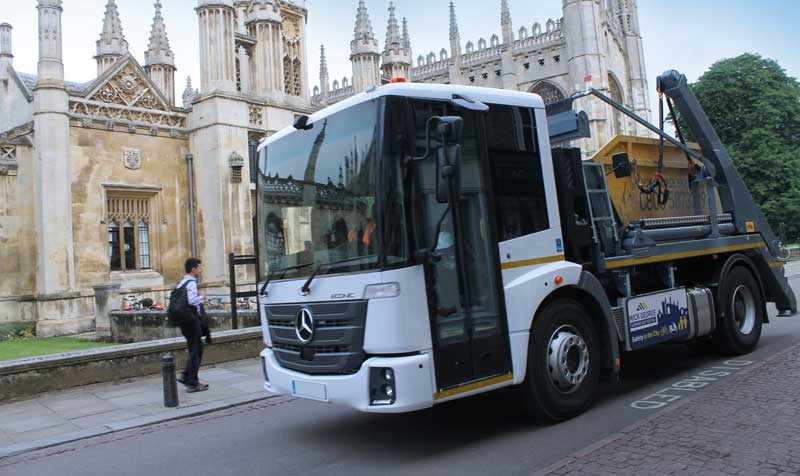
To show you just how poor this response is, look at the way one truck company in Cambridge, the cycling capital of the UK, is working on this. Mick George is phasing in these lorries where the driver can see much clearer.


In Depth


The presentation is very flash, there are lots of very cool images and videos, although embedded in a Powerpoint presentation so there's no way of pulling them up and analysing them bit by bit. Then, to add to the confusion, they are all based on the European standard of driving on the right. This does get very confusing, and probably especially so to any child that this is aimed at. Why do all this flash photo and video stuff, then not get it the right way round for the UK? It's not hard to do!

So, onto the key frames that are important. Here they are in one diagram.


So, A and B are about people walking not riding. Let's knock them off for now, although they are also pretty ridiculous. C is a definite stupid move from someone riding. I'm not sure anyone disagrees with that and also it's pretty obvious. What's the education statement here? Even young kids know this. Don't move out in front of a large vehicle. Duh!

Then there's D and E. Oh gosh, I don't know where to start. The diagram at D is a classic example of just very poor driving from the LORRY DRIVER. How did they overtake, then turn across the rider? When looking at the notes, this is not what the lesson is meant to be about, the diagram is very misleading. This is meant to show a lorry stopped at traffic lights, then a rider coming up the inside (on the wrong side for the UK), then the lights changing and the driver turning to the inside (on the wrong side for the UK). Has the driver indicated they are turning whilst stopped? No idea. Why are there no lines on the diagram showing a traffic light scenario? No idea. What educational value does this have set out like this? Really, really not sure it has any the way it's presented.

And then E. Again, not very clear what on earth this is about. Looking at the notes, this is meant to be a quick lane change due to something going on ahead. So, this is ON THE DRIVER again. They shouldn't be doing emergency moves into vulnerable road users, whatever is ahead.


And, as a final point to the absurd, the presentation has lots of film of people mountain biking. What on earth has that to do with utility riding? And, just to push another irrelevancy, one section starts with the silliness of not wearing a helmet. YES, I'd use a helmet when off-road jumping and risky riding. This has no relevance to road riding. Go on, show me how well that'll go down in The Netherlands. The land of cycling that virtually no-one uses helmets because they are not relevant. Or, importantly, will do ANYTHING FOR YOU IF YOU ARE HIT BY A LORRY.

So, to parody Macbeth, this a a flash, pretty presentation full of sound and fury signifying nothing. And yes, you need to look at the quote just before that.


What Should We Do When Riding?

Well, the first thing would be to not accept these dangerous lorries on our roads. They are designed dangerously. Simple. Another thing would be to press for places where people cyling and lorries do not mix. Again, design the danger out.

And, what's the positive thing to do right now? Simply put, read the Highway Code (221) that says don't ride up the inside of HGVs. Make sure you are seen by putting yourself in a position where you can see drivers. Look for mirrors. That's it. That's more than this presentation is about.

Further training, if you want it, is through #BikeAbility. This is so much more than this presentation. It involves quite a bit and teaches so much more. It's also taught to ~10 year old pupils in the UK, and around 2 million have been through it. Which does bring up another issue with this presentation. They are aiming it at 12 year olds. This is well behind the UK aim for training.

One thing can be said, there's no mention or visual image of hi-viz clothing or paint. I think Volvo got their fingers burnt when they did that little promotion a year or so ago. That's another story.


Final Marks


So, what's the final score for this? How much educational benefit does it have to people riding? Well, I think I'd give it a 1 out of 10. It does cover "don't pull out of a side road in front of a lorry".

Wednesday, 23 November 2016

Lincolnshire Police Give Really Poor Cycling Advice


So this appeared recently as a clipped section from Lincolnshire Police safety advice to children.


I thought the tweet comment was a reasonable summary of their poorly thought out leaflet. I thought it also deserved a lot more analysis and a good run through on how it directly and indirectly contradicts the GOVERNMENT advice on cycling practices, importantly the Highway Code and BikeAbility training.

Lincolnshire Police Leaflet.

The leaflet is here, although I've just focussed on the "on road" statements. It's rather telling that they choose to advertise to children by showing someone falling off. This is well known to play on children's fears and put them off riding. Not exactly a good way to encourage children.

So, the 4 statements they have asserted.
  • A. Never ride on the pavement. Keep to the cycling lanes or ride in the same direction as the cars. This is the law.
  • B. Before you turn a corner, check the way is clear (look behind you) and signal to tell people where you are going.
  • C. Keep a wide distance near parked cars they may siddeenly open a door.
  • D. Keep to single file on the roads, this is much safer.

Statement A.
This is just a really poorly written statement and easily misinterpreted. The "This is the law" bit makes it look like all parts of this are legal requirements. They are not.

1 "Never ride on the pavement". Except when it's a designated cycle path. As written in Highway Code rule 62: Cycle Tracks. These are normally located away from the road, but may occasionally be found alongside footpaths or pavements".

2. "Keep to cycling lanes". No, not a legal requirement at all or even good advice. BikeAbility says ride an arms length from the kerb. For multiple reasons this is the optimal position and is often at odds with poorly designed cyclelanes. This is subtly admitted in Highway Code rule 63: "Use of cycle lanes is not compulsory and will depend on your experience and skills".

3. "Ride in the same direction as cars" is the only bit that gets close to a legal requirement. Although I know many places that have one-way streets for cars that allow people to cycle the other way.

Statement B.
Again confusing. "check the way is clear (look behind you)" just doesn't make sense. It's because it's missing the reasoning and talking about what you are acutally doing.

It is good advice to look behind you and signalling is a good idea. However, the reasons why are completely overlooked and may result in riders doing completely the wrong thing. The idea about looking behind is to enable a rider to move out to a controlling position to stop poor overtaking close to a junction. Also, if there's no-one to signal to, don't do it, keep your hands on the handlebars.

Statement C.
The only statement that has my support. Always "a open door and a bit more" when passing a parked car. This is one of the biggest collision risks with people riding. I will note that advise to look behind when pulling out, vital if passing a parked car, is completely missing.

Statement D.
This is just plain wrong. Doubled-up riding is recommended when dealing with hazards. Making a group of riders look more like a car or bus means a great reduction in risky or rushed overtaking and from oncoming traffic (see here for more details why). Reguarly, BikeAbility instructors will move groups of children around on the road, and they'll employ doubled-up riding quite regularly and when appropriate.

In Highway Code Rule 66: "never ride more than two abreast, and ride in single file on narrow or busy roads and when riding round bends". So, that's not more than doubled up, and don't do it when it might be difficult to do. And to complement this, BikeAbility will teach riders to ride in the centre of a lane when narrow or round a bend to stop poor overtaking then.

In Summary.
It's really important that organisations of authority in the areas covering good cycling practices act and promote consistently. Whilst Lincolnshire Police probably were trying to do this, their half-handed attempt is, at best, poorly thought through. At worst it's just downright dangerous.

Here are all the GOVERNMENT sources of this advice for people cycling, which does seem at odds with what Lincolnshire police believe.

Thursday, 6 December 2012

The Supposed War on the Roads


The only thing worth doing directly with the quite short sighted and sensationalist BBC programme, in my view.

Complain to BBC under their Guidelines 3.4.6

You should use your own words. Mine were as the following section.

Footage of the "Alley Cat" race was not marked up as:
- professionally created "danger" footage
- over 6 years old

It was passed off as "normal" cyclist behaviour by associating it with the overall editorial concepts of the current rise of the helmet camera cyclists.

Why don't you produce something positive for all road users. I'd approach Chris Boardman to work on a programme on the benefits of cycling that would show people how safe roads are most of the time, how there is no "war", and how the more people do it the less our cities are congested (for all road users) and become liveable in.


Better still join a group you feel fits with the promotion of cycling you want. Like British Cycling, CTC, Sustrans, The Cycling Embassy of Great Britain, or local groups like London Cycling Campaign or Camcycle.

If you have time, promote the cycling you want using local connections at your councils and/or police and/or local political campaigners.

!! UPDATE  !!  !! UPDATE  !!  !! UPDATE  !!  !! UPDATE  !!  !! UPDATE  !!

I've had a reply from my complaint that reads as follows.

Thanks for contacting us regarding ‘The War on Britain’s Roads’ from 5 December on BBC One.

I understand you were unhappy with this programme as it used footage which you felt misrepresented cyclists.

Executive Producer on ‘The War on Britain’s Roads’, Samantha Anstiss, has written a blog following discussions on the show, including the segment on the Alley Cat footage you’ve mentioned. This can be found here:
http://www.bbc.co.uk/blogs/blogaboutthebbc/posts/A-range-of-opinions-and-perspectives-in-The-War-on-Britains-Roads

I hope this can go some way to reassuring you and I’d also like to assure you I've registered your complaint on our audience log. This is an internal report of audience feedback which we compile daily and is available for viewing by all our staff. This includes all programme makers and commissioning executives, along with our senior management. It ensures that your points, along with all other comments we receive, are considered across the BBC.

Thanks again for taking the time to contact us.


Well, in terms of reassurance, it makes me feel pretty angry. To palm off a complaint about failure to adhere to the BBC programming guidelines with a blog post by the excutive producer misses the point of the complaint entirely. The complaint requires investigation of the producer not a reply from them, it was them that broke the guidelines.

I've replied asking for them to actually reply to the complaint properly.

Previously I asked you to respond about the footage of the "Alley Cat" race, which was not marked up as:
- professionally created "danger" footage
- over 6 years old

These break your guidelines under point 3.4.6. Your response does not address this failure at all.


Again, join a group you feel fits with the promotion of cycling you want. Like British Cycling, CTC, Sustrans, The Cycling Embassy of Great Britain, or local groups like London Cycling Campaign or Camcycle.

If you have time, promote the cycling you want using local connections at your councils and/or police and/or local political campaigners.


!! SECOND UPDATE  !!  !! SECOND UPDATE  !!  !! SECOND UPDATE  !!

I've had a second response from the BBC.

Thanks for contacting us again regarding ‘The War on Britain’s Roads’.

I note that you still believe that viewers were misled by the footage of the so-called ‘Alley Cat’ courier race because the programme did not state the age of the footage or the fact that it had previously been released as part of a commercial DVD. We do not believe it was in any way dishonest to include the footage for the reasons that have already been explained in the executive producer’s blog.

The programme aimed to show many different types of road behaviour and this short extract was just one small element. We never suggested the clip showed normal or everyday activity, but the fact remains the footage depicted the real behaviour of couriers engaged in a real event. The blog explained that this was authentic footage shot by one of the cyclists involved in the race and that it had been subsequently posted online and released commercially.

If you would like to take the matter further, you can contact the BBC's Editorial Complaints Unit at Stage 2 of the complaints process and they will carry out an independent investigation. You must do this within 20 working days. You can email them at: ecu@bbc.co.uk , or alternatively write to them at the following address


And again, the response makes me feel pretty angry. Well, tired and angry. Tired because it feels like banging my head against a brick wall. Angry, as it's just the same fob off.

I'm sure that the BBC manages to get a drop off of complaints as a result of continuing to make people jump through more hoops to get the complaint genuinely reviewed. Alternatively, they may just feel they have to stick to their guns now, or it begins to look bad that they let the programme through in the first place.

There are two critical phrases. The first is as follows.

We never suggested the clip showed normal or everyday activity

But by not labelling as any different from the other headcam footage (specifically footage from a 3rd party depicting a paid for race) it IS saying it's the same. This is one reason why it should have been labelled, as specified in the BBC guidelines.

The second phrase is in the same sentence.

but the fact remains the footage depicted the real behaviour of couriers engaged in a real event.

We'll gloss over the fact that this conveys a completely different and contradictory meaning from the first part of the sentence. This does NOT depict everyday courier behaviour. It depicts a road race trying to break the rules. Saying it does is grossly misleading.


So, I have to work again, to follow through on the complain. The email left my outbox just a few moments ago.

I would like to complain about the BBC programme “The War on Britian’s Roads” broadcast on Wednesday, December 5th 2012 at 9pm on BBC1. Both replies to date fail to address the complaint.

Specifically the footage of the "Alley Cat" race towards the end of the programme. This was a race professionally created, specifically to look dramatic and reckless. Sources describing the interaction between the programme creators and race creators exist here (in case you didn’t already know!).
http://buffalobillbikeblog.wordpress.com/2012/12/12/lucas-brunelle-the-king-of-new-york-and-the-war-on-britains-roads/
http://www.bikebiz.com/news/read/bbc-doc-portrays-dvd-stunt-cycling-footage-as-standard-behaviour/014036

This was not marked up as:
- professionally created footage
- over 6 years old
- specifically set to break all the roads on the road

It was passed off as "normal" cyclist behaviour by associating it with the overall editorial concepts of the current rise of the helmet camera cyclists.

This clearly breaks BBC Guidelines 3.4.6.


Again, join a group you feel fits with the promotion of cycling you want. Like British Cycling, CTC, Sustrans, The Cycling Embassy of Great Britain, or local groups like London Cycling Campaign or Camcycle.

If you have time, promote the cycling you want using local connections at your councils and/or police and/or local political campaigners.