Showing posts with label Road. Show all posts

Tuesday, 4 April 2017

Back Out on the Hildersham Circuit


Contents

Intro

So, I work outdoors with bikes. Yee haa! Lucky me!

However, this isn't all the roses and happiness it can be. Sadly, over the winter term, I'm really rather reticent to spend my weekends going outdoors very much. Whilst friends are shooting off for a good time in fields and on tracks, I'm sat there going "No thanks, just done that for the past five days".

Then Spring comes along and all that "stay in" feeling disappears. This weekend was very much that time. The blooms where blooming and the blossom, er, blossoming. It was time to be outdoors on my bike for the fun of it!

I usually end up on a simple 20 mile circuit to the south of Cambridge. Luckily, there's plenty of decent off-road routes, bike paths, and (at worst) quiet roads. I get down as far as Hildersham on my way dropping through Cherry Hinton and Fulbourn on the way there, then Abington and Babraham on the way back, This time, I had the new Babraham Institute path in mind, rather than Stapleford and Shelford. It's more direct and I wanted to find out what it was like.

Map


So the clip starts near the station on Hills Road (and ends in the same place!) and heads out through Cherry Hinton. The first bit shows how poor the station area has become with the new development. The cycle bridge is a welcome removal from that poor environment taking us over to Romsey Town and then on to the pleasantries of The Tins. A final wiggle through Cherry Hinton and we're on the cycle route to Fulbourn.


Path from Marmora Street


The Tins

After Fulbourn, it's up into the hills. Well, what counts for hills in these parts. They are still very pleasant with lots of people enjoying the outdoors, with all kinds of animals! The roman road of Worsted Street affords a great route south with stunning views over the landscape. Small hillocks dot the landscape, along with the odd majestic wind farm.


Daffodils south of Fulbourn


Horses on a Walk


Woody Worsted Street

Hildersham is a delightful little village, with a pretty bridge (and ford for over 12 tons) at the centre. And then the Pampisford Road round behind Abington towards Granta Park, which is pleasant enough. Then, a short section of unpleasant road, often with 1 or 2 cars only but doing 70mph, sometimes far too clsoe for no reason gets us to the footbridge over the A11.


Hildersham Bridge


A11 Bridge

And this is the one weak link here. It's a "converted" footbridge. It's a long distance up and down on very steep metal tracks. Not something I can do with a normal commuting load. The down section is just as difficult, as I can't brake even with walking the bike. I was working nearby recently, and simply had to drive because this isn't a choice when commuting. And sorry too that this blocks cargobikes, different ability bikes, young and old people, and anyone that can't hold onto a lot of weight.


A11 Bridge Path

Once in Babraham, turning left towards the Institute entrance felt odd, I'm used to heading to Sawston. Avoiding the narrowed spaces near the school is good though. And it's into the Institute!

I've done this in more detail here. The funny little start section is possibly good, not quite sure. I'd think it adds to the option if traffic is backed up on the main road, but does lose the priority as you come back out again. Then I was a little concerned about where to go. There were bike symbols on the road, but people ride into the Institute itself so didn't give me a strong feeling of going in the right dirction. Then, a sign appeared in the distance and helped guide across a rather odd "Stop" line and onto the path itself.


Babraham Institute Entrance


Access to Babraham Institute Path

The path was open, smooth, and thankfully not absolutely straight. It's not near trees, so root damage is unlikely. The park is quite pleasant to ride through and there's plenty to look at. Changing angles regularly helps that as well as to stop the boredom sinking in of constantly going in exactly the same direction.


Tree on Babraham Insitute Path

At the end, the route out to the cyclepath over the Magogs seems sensible. You have to cross the A1307 and having it just a few metres form the roundabout is fine. There is a central refuge, and thankfully it's not staggered the way town street designers get wrong.


Exit from Babraham Insitute Path

The path over the Magogs is, well, next to a busy road. It's pleasant enough when a Sunday, not quite sure how it'll be on a weekday. And, from this direction, it feels like quite a way up! It's really not very far up, totalling 45 metres, it's just it starts about a mile out and slowly ramps up. It feels like it's gone on for ages! Still, it's next to pleasant beech woods for the steeper second section. And also, there's all that potential energy to release on the way down!


Bench at theTop of the Magogs

Finally, the route into Cambridge has it's pros and cons. Whilst it's a good route as you start to come into town, you suddenly have to switch sides. Although there's a section around 200 metres long with cycle routes on both sides, it's just not long enough to find a gap. Getting onto the new Hills Road Cyclepath is great, although there's no guarentee it'll be clear, and you have to mix it again at the bridge.


Floating Bus Stop


Video

And here's the clip (music warning!) with a variety of start points which open YouTube in a separate window.
Go HD see * at bottom

At the start
00:32 Cycle Bridge
00:57 Marmora Path
01:07 The Tins
01:40 Cherry Hinton High Street
01:58 Fulbourn Cycle Path
02:27 Fulbourn
03:05 Babraham Road Avenue South
04:07 Worsted Street
05:01 Crossing the A11
06:15 Path to Hildersham (stunning views)
06:50 Hildersham
07:12 Crossing the A1307 to Pampisford Road
07:36 Abington
08:05 Granta Park
08:20 A11 Footbridge
09:00 Entrance to Babraham Institute
09:30 Crossing the A1307 to Cyclepath
10:39 Top of the Magogs
11:16 Back into Cambridge
11:49 Hills Road Cyclepath


The music is in sections too, all from the Film "Moulin Rouge" and they roughyl follow different areas of the video.

00:12 Sparkling Diamonds, getting out of Cambridge and through Fulbourn to open country
03:05 Spectacular Spectacular, riding up into the hills
04:12 Because we Can, riding along the off-road section and back towards Cambridge
07:40 Bolero, the Institute path and steadily getting back into Cambridge


* How to go HD.


Thursday, 1 December 2016

Traffic Calming


So NICE have come up with some important things about how poor our road infrastructure is and how it increases pollution.


I'm especially pleased to see they've pointed out the negative issues speed humps cause.
“Traffic calming measures such as speed humps ... may increase emissions by adding to decelerations and accelerations,” it says. “Ensuring motorists drive steadily at the optimum speed can reduce stop-go driving and reduce emissions.
I'm sad to see they don't talk about the better alternatives, just what doesn't work. I'm sure a lot of motorheads will start yelling "Rip them out now, pollution, think of the children (and let me speed without concern for others)". Obviously, completely the opposite of what NICE is suggesting, although it'd be "nice" if they pointed that out.

Again, we've not got far to go before we see what does work, it's just over the North Sea in, yes, The Netherlands.The Telegraph did a piece (all the way back in 2012) on how they work it out with something called "woonerfs". There are 3 principles behind these areas:
  • traffic speeds are forced down to "footpace", typically well below 12mph. 
  • the principles are applied consistently nationwide so they are instantly recognised by road users everywhere. 
  • legal liability is heavily weighted against the motorist in the event of an accident.
It's interesting to note that this has support from the population and professional drivers organisations.

The piece then talks about how this is engineered on the ground.
Clever use of planting, play areas, chicanes, even the position of the houses, means there isn't a straight road in sight.
And it's praise of the result is great!
there's little need for speed signs; our pace automatically falls to a crawl, underlining the designers' dream that children should roam the streets in safety
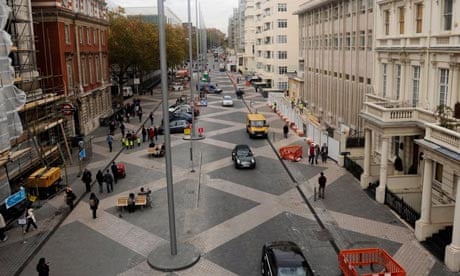
Note that this starts to sound like UK schemes like Exhibition Road which many speed campaigners really don't like. But compare the "Clever use" quote above and look at the picture of this development and you can easily see how the UK scheme totally fails. It's a massive straight space, encouraging speeding and, as a result, pushing other transport modes out of the way.


So, why can't we do this in the UK? Actually we already do. Look at new developments in St Neot's and Peterborough.

In Hargate, a new development south of Peterborough, you'll find it hard to find a place with a straight road. Additionally, there are no quick routes through, no road to start on that'll take you all the way through. You have to know your way and make a variety of turns.


Entering (picture shows leaving) St Neots from the east and the road wiggles around, for no obvious reason. There's space for it to go straight, but it doesn't, it has an open space with trees instead. This naturally slows everyone driving down without thinking about it.


These two areas are showing the main signs of the engineering of woonerfs, although still have a few things to work on. And, of course, it's missing the principle priority issue. The result is ground breaking, as The Telegraph points out.
woonerfs are not only possible but desirable, because they transform neighbourhoods into garden cities
underlining the designers' dream that children should roam the streets in safety
Not only do The Netherlands do this with new developments, but they retrofit older neighbourhoods. The've figured out it's not that difficult to do, unlike our country that seems to accept the blank myth that "we don't have space". We do, we just choose not to be clever about it. The Dutch have been clever.
Woonerfs have been retro-fitted over several square miles of side roads
And to complete the quote from above.
Amsterdam proves that retro-fitted woonerfs are not only possible but desirable, because they transform neighbourhoods into garden cities
So, while we moan about pollution, invest vast sums of money in speeding up our journeys on major trunk roads by a few minutes for a few years only (before it returns to the same old congestion), there's great examples of what we can do to transform our neighbourhoods and remove urban pollution at the same time.

Wednesday, 5 August 2015

Daytime Bike Lights


This article appeared in Road.cc yesterday with a large variety of comments underneath, precisely why they write in this thought provoking manner!


So, should riders have a rear light on all the time? It would seem like a sensible idea, another bit of added safety measure, what's not to like?

I notice a lot of people answering "yes" in the comments section. And a number repeating anecdotal events "proving" it works. Or even go into bold and largely unproven statements. A number of these comments also give a clue as to the riders normal riding experience. It would look like a large number are hardcore road riders, likely to have a good road bike, wear lycra, use helmets, and buy in to all the gadgets you can get for the bike. That's their hobby, the part of their life on which they'll spend money.

What about the ordinary rider, one just going to work or school every weekday morning? One simply using a bike as their transport. Someone who's not likely to want extra stuff for their "precious machine". It's not their hobby, just a way of getting around. Their bike is subsumed into their overall style, not the other way round.

So, my thoughts....

There are two types of "compulsion" that have similar levels of effect, of trumping out any evidence-based decision making. Legal mechanisms is the obvious one, but also emotional blackmail is another less obvious and more insipid form. "Just do it", "think of your children", "it's for safety's sake" are all used in these arguments in a neat way of avoiding any real information about the effects of whatever it is being suggested. This additional "safety tip" fits into the latter.

The issue of the slippery slope, in this country in particular, is that we makes safety the responsibility of the victim and not the one responsible for creating the danger.

On QI, Jeremy Clarkson, no less, said the best road safety device was to remove all seatbelts and put a big spike in the middle of the car steering wheel. That way the driver would be so concerned about their own safety they'd never impinge upon anyone else's outside.

The same piece pointed out that whilst seatbelts made a great safety improvement on people in cars, it had a detrimental effect on those not in cars. More people were KSIed outside of cars as average speeds went up as it had less effect on those causing the higher speeds.

We keep lessening the risks for those responsible for creating the danger, not those facing it. And this has been happening on the roads for as long as they've been around, with each time it happens it goes though a process.

  • Initial proposal. Proponents, sometimes with a benefit to gain (like Trek/Bontrager here), suggest a new thing. Some people see it as removing responsibility from the risk giver and challenge the safety aspect.
  • Those with budgets (and something to gain) keep pushing it, and it gains traction against those who've nothing but their sense of the importance of "responsibility".
  • Institutions take on the new idea and run with it. Eventually it ends up being legally or emotionally supported.
  • Some years or decades later it's taken as read that the idea is an important part of safety, not to be ignored or challenged.

To illustrate this, how about the need for lights on bikes at night. This is a legal requirement and you'll find very few people across the whole cycle advocate spectrum that'll disagree with it.

However, when bike lights were first proposed, many riders opposed it. They had a simple reason: it was the responsibility of the driver to see where they were going and ensure that they were not going to drive into anybody or anything. They suggested it was the drivers responsibility to drive safely.

Then it was taken through the above stages. Now, no-one would fight it.

We do have a number of people ride around without lights in Cambridge. Whilst I'd never join them, when I drive at night, especially at 20mph, I do notice that if I'm paying attention to what I'm doing, then I do see them.

One of the biggest ironic statements from those with anti-cycle sentiments is:
  • "Look at that bloody cyclist, no bloody lights, they'll never be seen."