Showing posts with label Poor. Show all posts

Saturday, 3 December 2016

Volvo Road "Safety" Programme


Fantastic! Some altruristic company that makes trucks is finally acknowledging their part on keeping vulnerable road users safe. I can't wait!


But then I looked through the "educational kit" material. Oh, it's for people riding only, with a few notes about how hard it is for people driving, because obviously they are the only people thinking about this. Hmmm.

Well, let's keep going. I was thinking there would be lots of "see and be seen" actions that are taught in #BikeAbility, about moving out and holding the right part of the road from an early position, about getting eye contact, about signalling, about knowing when you have priority. And how people driving respond to that.

But no, there's none of that.


A Bit More Analysis


There's lots of pretty pictures, lots of photos showing sharks have sharp teeth and cactuses have sharp needles. Yes, I hear you asking, quite what that has to do with cycling? I've no idea too!

The only bit that has any relevance to road cycling is a few diagrams showing where truck drivers can't see people low down. Yes, this is just a sexed up version of Exchanging Places.

So, let's just get this straight. A company that can design a truck so that the driver could see people lower than their cab, doesn't do it. Something in their control and THEY DON'T DO IT. They just tells others that their lorries are designed NOT TO SEE YOU.

To show you just how poor this response is, look at the way one truck company in Cambridge, the cycling capital of the UK, is working on this. Mick George is phasing in these lorries where the driver can see much clearer.
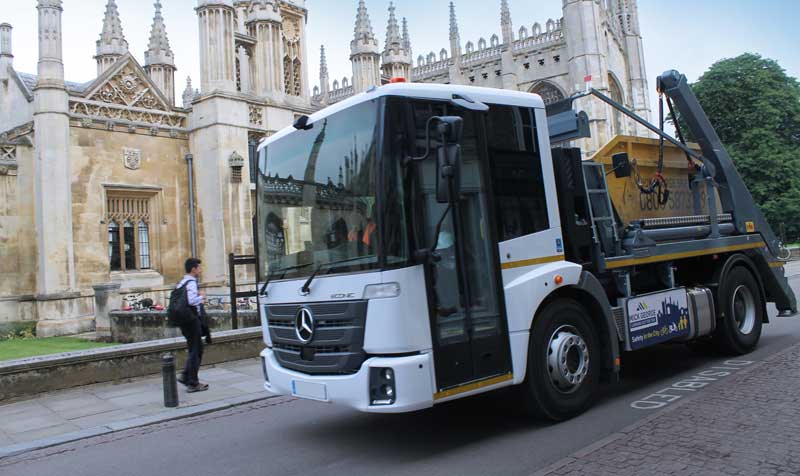


In Depth


The presentation is very flash, there are lots of very cool images and videos, although embedded in a Powerpoint presentation so there's no way of pulling them up and analysing them bit by bit. Then, to add to the confusion, they are all based on the European standard of driving on the right. This does get very confusing, and probably especially so to any child that this is aimed at. Why do all this flash photo and video stuff, then not get it the right way round for the UK? It's not hard to do!

So, onto the key frames that are important. Here they are in one diagram.


So, A and B are about people walking not riding. Let's knock them off for now, although they are also pretty ridiculous. C is a definite stupid move from someone riding. I'm not sure anyone disagrees with that and also it's pretty obvious. What's the education statement here? Even young kids know this. Don't move out in front of a large vehicle. Duh!

Then there's D and E. Oh gosh, I don't know where to start. The diagram at D is a classic example of just very poor driving from the LORRY DRIVER. How did they overtake, then turn across the rider? When looking at the notes, this is not what the lesson is meant to be about, the diagram is very misleading. This is meant to show a lorry stopped at traffic lights, then a rider coming up the inside (on the wrong side for the UK), then the lights changing and the driver turning to the inside (on the wrong side for the UK). Has the driver indicated they are turning whilst stopped? No idea. Why are there no lines on the diagram showing a traffic light scenario? No idea. What educational value does this have set out like this? Really, really not sure it has any the way it's presented.

And then E. Again, not very clear what on earth this is about. Looking at the notes, this is meant to be a quick lane change due to something going on ahead. So, this is ON THE DRIVER again. They shouldn't be doing emergency moves into vulnerable road users, whatever is ahead.


And, as a final point to the absurd, the presentation has lots of film of people mountain biking. What on earth has that to do with utility riding? And, just to push another irrelevancy, one section starts with the silliness of not wearing a helmet. YES, I'd use a helmet when off-road jumping and risky riding. This has no relevance to road riding. Go on, show me how well that'll go down in The Netherlands. The land of cycling that virtually no-one uses helmets because they are not relevant. Or, importantly, will do ANYTHING FOR YOU IF YOU ARE HIT BY A LORRY.

So, to parody Macbeth, this a a flash, pretty presentation full of sound and fury signifying nothing. And yes, you need to look at the quote just before that.


What Should We Do When Riding?

Well, the first thing would be to not accept these dangerous lorries on our roads. They are designed dangerously. Simple. Another thing would be to press for places where people cyling and lorries do not mix. Again, design the danger out.

And, what's the positive thing to do right now? Simply put, read the Highway Code (221) that says don't ride up the inside of HGVs. Make sure you are seen by putting yourself in a position where you can see drivers. Look for mirrors. That's it. That's more than this presentation is about.

Further training, if you want it, is through #BikeAbility. This is so much more than this presentation. It involves quite a bit and teaches so much more. It's also taught to ~10 year old pupils in the UK, and around 2 million have been through it. Which does bring up another issue with this presentation. They are aiming it at 12 year olds. This is well behind the UK aim for training.

One thing can be said, there's no mention or visual image of hi-viz clothing or paint. I think Volvo got their fingers burnt when they did that little promotion a year or so ago. That's another story.


Final Marks


So, what's the final score for this? How much educational benefit does it have to people riding? Well, I think I'd give it a 1 out of 10. It does cover "don't pull out of a side road in front of a lorry".

Wednesday, 23 November 2016

Lincolnshire Police Give Really Poor Cycling Advice


So this appeared recently as a clipped section from Lincolnshire Police safety advice to children.


I thought the tweet comment was a reasonable summary of their poorly thought out leaflet. I thought it also deserved a lot more analysis and a good run through on how it directly and indirectly contradicts the GOVERNMENT advice on cycling practices, importantly the Highway Code and BikeAbility training.

Lincolnshire Police Leaflet.

The leaflet is here, although I've just focussed on the "on road" statements. It's rather telling that they choose to advertise to children by showing someone falling off. This is well known to play on children's fears and put them off riding. Not exactly a good way to encourage children.

So, the 4 statements they have asserted.
  • A. Never ride on the pavement. Keep to the cycling lanes or ride in the same direction as the cars. This is the law.
  • B. Before you turn a corner, check the way is clear (look behind you) and signal to tell people where you are going.
  • C. Keep a wide distance near parked cars they may siddeenly open a door.
  • D. Keep to single file on the roads, this is much safer.

Statement A.
This is just a really poorly written statement and easily misinterpreted. The "This is the law" bit makes it look like all parts of this are legal requirements. They are not.

1 "Never ride on the pavement". Except when it's a designated cycle path. As written in Highway Code rule 62: Cycle Tracks. These are normally located away from the road, but may occasionally be found alongside footpaths or pavements".

2. "Keep to cycling lanes". No, not a legal requirement at all or even good advice. BikeAbility says ride an arms length from the kerb. For multiple reasons this is the optimal position and is often at odds with poorly designed cyclelanes. This is subtly admitted in Highway Code rule 63: "Use of cycle lanes is not compulsory and will depend on your experience and skills".

3. "Ride in the same direction as cars" is the only bit that gets close to a legal requirement. Although I know many places that have one-way streets for cars that allow people to cycle the other way.

Statement B.
Again confusing. "check the way is clear (look behind you)" just doesn't make sense. It's because it's missing the reasoning and talking about what you are acutally doing.

It is good advice to look behind you and signalling is a good idea. However, the reasons why are completely overlooked and may result in riders doing completely the wrong thing. The idea about looking behind is to enable a rider to move out to a controlling position to stop poor overtaking close to a junction. Also, if there's no-one to signal to, don't do it, keep your hands on the handlebars.

Statement C.
The only statement that has my support. Always "a open door and a bit more" when passing a parked car. This is one of the biggest collision risks with people riding. I will note that advise to look behind when pulling out, vital if passing a parked car, is completely missing.

Statement D.
This is just plain wrong. Doubled-up riding is recommended when dealing with hazards. Making a group of riders look more like a car or bus means a great reduction in risky or rushed overtaking and from oncoming traffic (see here for more details why). Reguarly, BikeAbility instructors will move groups of children around on the road, and they'll employ doubled-up riding quite regularly and when appropriate.

In Highway Code Rule 66: "never ride more than two abreast, and ride in single file on narrow or busy roads and when riding round bends". So, that's not more than doubled up, and don't do it when it might be difficult to do. And to complement this, BikeAbility will teach riders to ride in the centre of a lane when narrow or round a bend to stop poor overtaking then.

In Summary.
It's really important that organisations of authority in the areas covering good cycling practices act and promote consistently. Whilst Lincolnshire Police probably were trying to do this, their half-handed attempt is, at best, poorly thought through. At worst it's just downright dangerous.

Here are all the GOVERNMENT sources of this advice for people cycling, which does seem at odds with what Lincolnshire police believe.

Wednesday, 29 October 2014

Cherry Hinton Useless Cyclelane


I filmed the cyclelane on Cherry Hinton Road from a drivers perspective whilst viewing other people's treatment and driving around it. It becomes apparent that people driving can't cope with it and regularly fail to respond to it correctly.

I'd argue that the cyclelane itself is thus useless and that it could be considered dangerous to use by people riding.

I believe the cyclelane is relatively new as not on the Google satellite image but do appear on the Google Streetview here. Note that looking through the Google Streetview photos, I'm not alone in finding issue with the cyclelane!

Looking in detail we have several issues.
  • Evidence shows that if a cyclelane is painted on the side of a road, people driving tend to place their vehicles closer to riders as they pass. So to include one on a road you have to be fairly sure that it will help people driving stay well clear. In most cases this simply doesn't work.
    • Essentially, people driving tend to view the cyclelane as another lane on the road where simply being inside the lines either side is good enough.
    • People riding need space on the road bigger than the cyclelane. This is recognised in BikeAbility cycle training and the Highway Code (Rules 163 and 213). This is for wobble room (a gust of wind, a large pothole), just in case they fall over (same reasons), and to avoid airwash from passing vehicles.
  • This road is only just wide enough to include an on-road cyclelane and the two lanes going either way. (Note that there is plenty of space a lot of the way down the road outside of the roadspace.) A non-mandatory (dashed lines) cyclelane means cars can use it when necessary. Obviously this is open to interpretation. 
    • However, if when necessary includes simply when is a straighter line along the road than if not, the whole concept of having a cyclelane in the first place is pointless. It adds no safety to anyone riding. If a painted lane can't train people driving to avoid space for cycling then what's the point in having it?
  • On a section towards the end, the cyclelane passes some off-road space where cars are parked. Again, BikeAbility cycle training (PDF page 20) tells anyone riding to not use the cyclelane space. If a door opens, anyone riding in the cyclelane will have their safety seriously compromised. 
    • Training says move out to being in a space that'd be just outside the cyclelane (where the left handlebar would have plenty of space from an opened door).
  • On several occasions, the cyclelane passes a side road. Again, BikeAbility cycle training (PDF page 21) tells anyone riding to not use the cyclelane space. If someone drives from the side road but fails to stop accurately at the Give Way line (which happens a lot), anyone riding in the cyclelane will have their safety seriously compromised. 
    • Training says move out to being in a space that'd be just outside the cyclelane.

Quite why, in the leading city for cycling in the UK, we are still getting such awful infrastructure diminishing any budget for proper, safe build is laughable if it wasn't so serious.


Here's a few more pictures from Google Streetview showing the failure of people to deal with this cyclelane along with the satellite view showing no cyclelane up until recently.